The Colossus of Rhodes, Greece, in brief
The Colossus was a bronze statue of the sun god Helios. The statue is attributed to Chares of Lindos. Scholarly overviews date its construction to roughly 292 to 280 BC and put its height at about 33 metres. No measurements survive, so the figure is an estimate.
The statue stood on Rhodes until an earthquake brought it down. That quake is usually dated to 226 BC, although some accounts give 228 or 226 BC. This page keeps that uncertainty instead of picking a side. What has made the Colossus famous in later centuries, the giant straddling a harbour, is a different matter, and we deal with it below as a legend.
What is documented and what is not
A quick sorting of the main claims about the Colossus.
| Claim | Status | Detail |
|---|---|---|
| A bronze statue of Helios | Documented | Described in scholarly overviews of the monument. |
| Made by Chares of Lindos | Attributed | Attributed to him in scholarly overviews. |
| Built around 292–280 BC | Approximate | One Greek tourism page places it in the 4th century BC, so dates differ. |
| About 33 m high | Estimate | No surviving measurement exists. |
| Destroyed by an earthquake | Documented, date uncertain | Usually 226 BC, sometimes given as 228 or 226 BC. |
| Exact location | Unknown | Several sites have been proposed. None is secured. |
| Legs spread over the harbour entrance | Legend | A medieval image, not archaeological evidence. |
| Feet on today's deer columns | Legend | Not documented in any source. |
Rhodes city tours and day trips
Walking tours of Rhodes Town, the harbour and the Old Town, plus day trips across the island, with live prices and availability.
Colossus of Rhodes location: where did it stand?
Nobody knows exactly. Researchers have suggested several locations, and none is secure. If a guide or a sign tells you the statue stood at one precise spot, treat that as one theory among others.
The date question is similar. Most scholarly overviews give 292 to 280 BC for the work. The Greek national tourism organisation, on another page about Rhodes, simply places the building in the 4th century BC. The two statements do not match, and we show both rather than blending them.
The story in four steps
The documented part is short. Most of what people repeat comes later.
Around 292 to 280 BC
The bronze statue of Helios is built, attributed to Chares of Lindos. Some sources give a looser date in the 4th century BC.
Lindos →Around 226 BC
An earthquake brings the statue down. Some accounts give 228 or 226 BC.
Medieval times
A depiction appears showing the figure with its legs apart over the harbour entrance. This is the picture most people know.
Today
The harbour at Mandraki carries the legend in its two deer columns and three windmills.
The legend of the giant over the harbour
The picture most people have in their heads is a bronze figure with legs apart, ships sailing between them into the harbour. That scene is a later depiction from medieval times. It is not archaeological proof of where the Colossus stood or how it was posed.
So the deer columns you see today at the harbour mouth are not the place where its feet stood. Nothing in the sources supports that. The Greek tourism organisation introduces the connection between Mandraki and the Colossus as a legend, and that is the right way to read it.
The Colossus of Rhodes today: what you can see at Mandraki
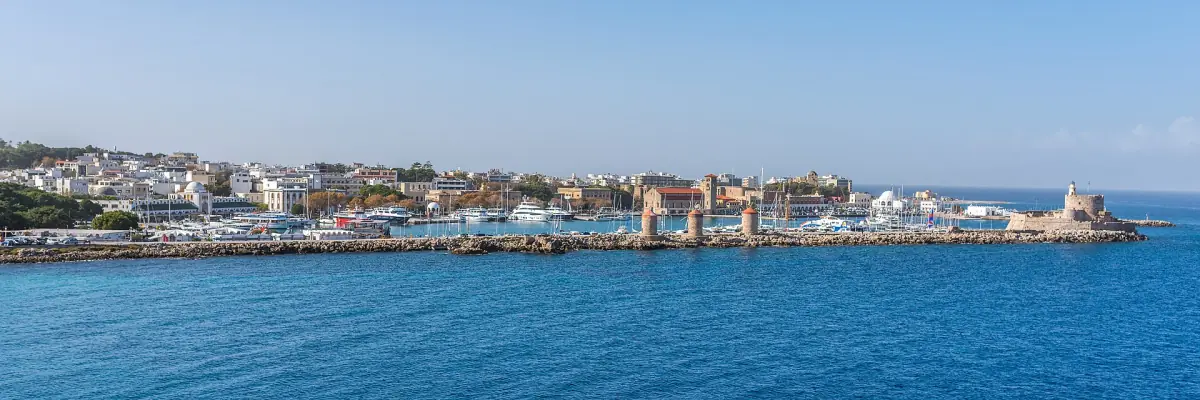
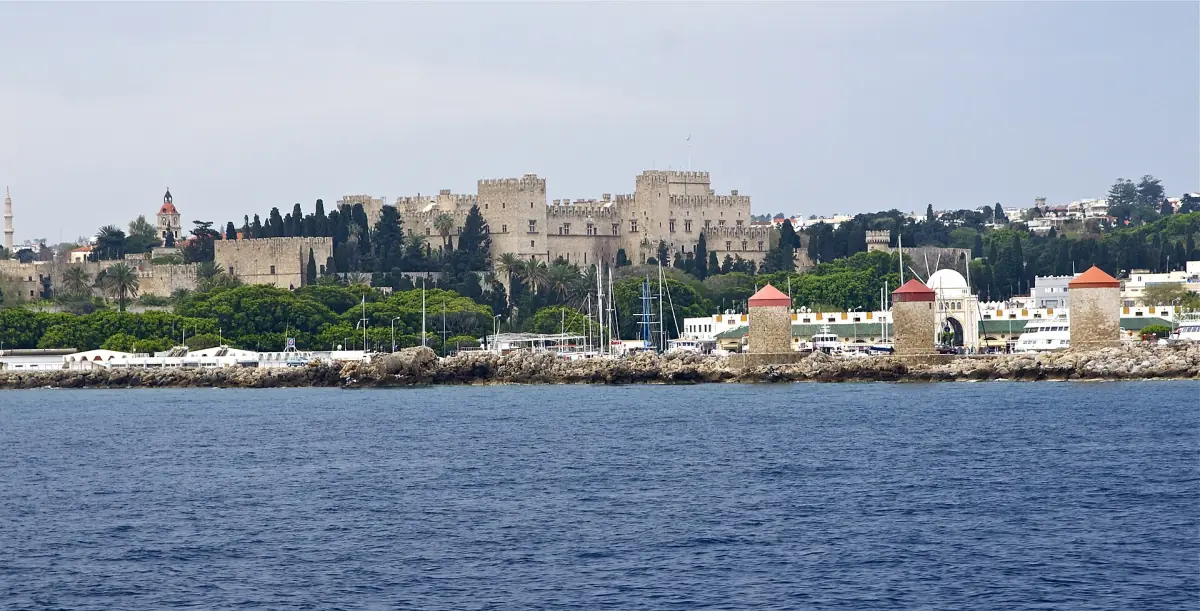
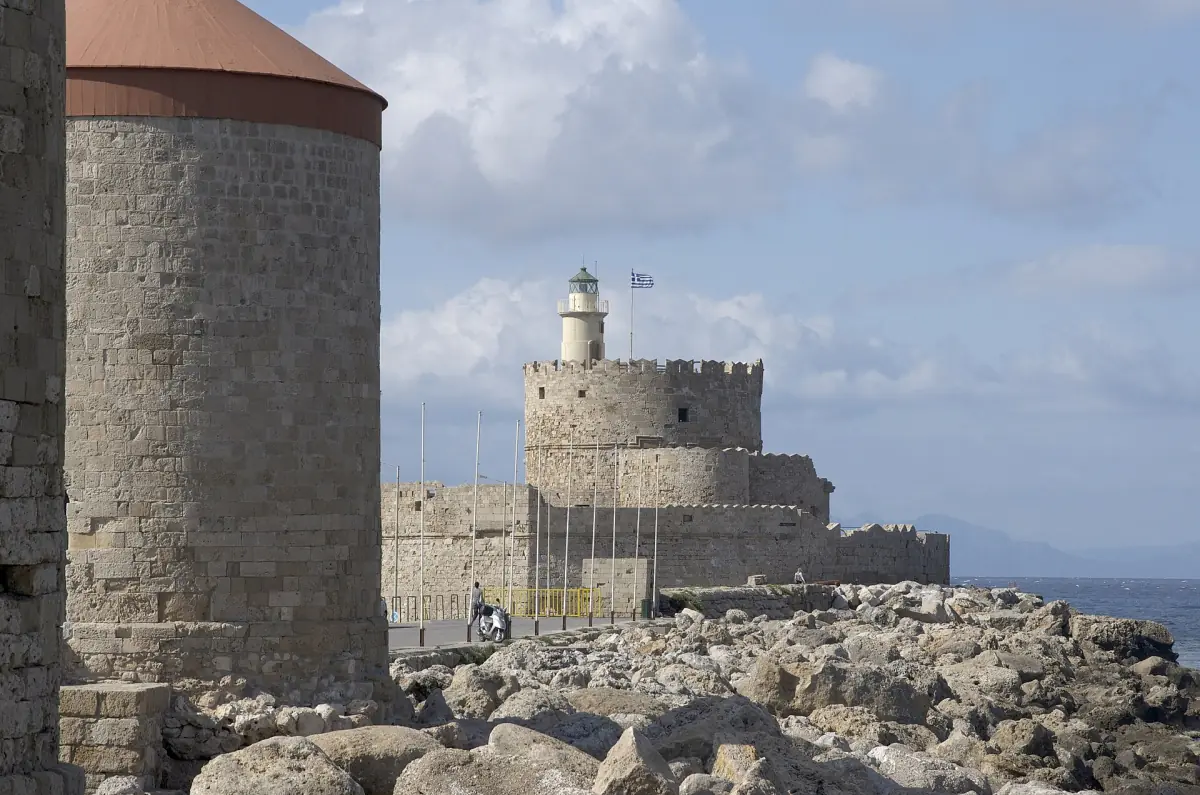
Mandraki is the small harbour in Rhodes Town. At its entrance two bronze deer stand on columns. The Greek tourism organisation also lists three windmills there. The fort of Agios Nikolaos and a windmill also stand at the harbour.
Seen from the sea, the harbour front and the towers of the Grand Master's Palace come into the same view. On foot, it makes an easy start to a day in the city: look at the deer columns, think about the story of the statue, then continue into the Old Town.
The sights with tickets and set opening hours, from the Street of the Knights to the palace, are covered in our Old Town guide.
What happened to the Colossus of Rhodes
The history of the Colossus of Rhodes is short on documented facts. The statue stood on Rhodes until an earthquake brought it down, usually dated to 226 BC, though some accounts give 228 or 226 BC.
Colossus of Rhodes remains
The sources used for this guide do not document any remains of the Colossus that visitors can see. Treat any sign or tour that promises remains with caution, and ask what exactly is being shown.
The Colossus statue and the Seven Wonders
The Colossus statue is counted among the Seven Wonders of the ancient world. That fame is one reason the legend of the giant over the harbour is so widespread, even though it is a later image and not proof of how the statue looked.
How to read claims about the Colossus
You will meet many confident statements about the Colossus on signs, in tours and online. A few habits help. Look for words such as attributed, estimated and approximately: they mark the parts that are not firm. Treat anything about a precise pose or a precise spot as a theory. And when a text calls the harbour link a legend, take it at its word.
None of this makes the story less interesting. A bronze figure of the sun god, remembered for centuries after it fell, is a good reason to spend an hour at the harbour. The point is only to keep the evidence and the picture apart.
Making the most of a visit
Practical points for a stop at Mandraki.
Pair it with the Old Town
The palace, the Street of the Knights and the museum are the places with tickets and opening hours. See the Old Town guide for 2026 prices.
Pick your light
The harbour is an outdoor place. Early or late in the day is more comfortable in summer, and winter has its own weather. Our weather guide covers the seasons.
Add a beach
Elli is the city beach by the aquarium, with a jumping platform. See all the options in our beaches guide.
Join a guided walk
A guide can help you read the harbour and the story. Check the description for what is included and for how the tour treats the legend.
Tours →Colossus of Rhodes: frequently asked questions
What was the Colossus of Rhodes?
A bronze statue of the sun god Helios, attributed to Chares of Lindos and built around 292 to 280 BC according to scholarly overviews. It stood about 33 metres high, as far as can be estimated.
Did the Colossus straddle the harbour?
That is a legend. The image of the figure with legs apart over the harbour entrance comes from a later, medieval depiction and is not archaeological proof.
Where exactly did the Colossus stand?
The exact location is not secured. Several proposals exist.
Can I see the Colossus today?
Do not expect the statue itself. At Mandraki harbour you can see two bronze deer on columns and three windmills, and the Old Town is nearby.
When did the Colossus fall?
In an earthquake, usually dated to 226 BC. Some accounts give 228 or 226 BC.
Do the deer columns mark where the Colossus stood?
No. That link is presented as legend. Do not read the columns as the position of the statue's feet.